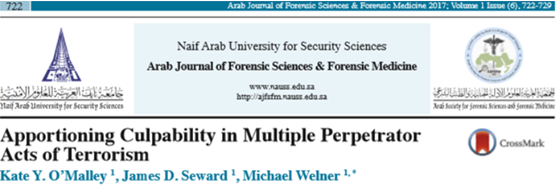
Riyadh – In a recently published article in the Arab Journal of Forensic Sciences and Forensic Medicine, researchers at The Forensic Panel demonstrated the important role the Depravity Standard can play in bias-free determinations of who is more culpable in multiple perpetrator murders.
In the paper Apportioning Culpability in Multiple Perpetrator Acts of Terrorism, researchers Kate O‘Malley, Dr. Jim Seward, and Dr. Michael Welner examined three well-chronicled terrorism cases from recent memory; the 1993 Oklahoma City bombings as perpetrated by acquaintances Timothy McVeigh and Terry Nichols; the 2013 Boston Marathon bombings perpetrated by brothers Tamerlan and Dzokhar Tsarnaev; and the 2015 San Bernadino mass shooting carried out by Syed Rizwan Farook and Tashfeen Malik, a married couple.
Using validated definitions of the twenty-five item Depravity Standard instrument, the researchers reviewed publicly available evidence of the intent, actions, victim choice, and attitude of each of the perpetrators. The goal was to determine whether either of the two perpetrators in each pair exhibited more features of depravity compared to the other. And if so, to what degree these findings conformed with the broader public portrayal of the crimes.
O’Malley and colleagues found Timothy McVeigh to have demonstrated more qualities of depravity than Terry Nichols in the Oklahoma City bombing. This is consistent with the documented roles each played in the crime, and the punishments levied against each of them. On the other hand, there was no difference in the number of Depravity Standard items reflected in the case analysis of the Tsarnaev brothers. The researchers pointed out that this finding undercut the public portrayal of Dzokhar Tsarnaev at times as a lesser actor pulled along by his aggressive older brother.
Likewise, The Forensic Panel researchers found no difference between San Bernadino killers Farook and Malik in the number of Depravity Standard items present. Presumptions about submissiveness of women in Islam and gender culpability in general were not reflected in the evidence as it filtered through the Depravity Standard assessment.
Reflecting on the findings, Kate O’Malley noted, “This pilot study demonstrated the efficacy of the Depravity Standard in teasing out culpability in murders with more than one perpetrator. When investigating terrorism events there is currently no standardized way to determine how depraved the actions of the person who detonates the bomb are, compared to the event organizer, the bomb maker, the person who films it for social media, and the person who drives everyone to the scene. Instinct tells us that some actors are more responsible for the deaths themselves, but the Depravity Standard looks beyond who actually pressed the button and highlights depravity in the intent, planning, and attitudes of others involved and informs culpability at a granular level. This will allow for more fair justice determinations that focus relevant investigation.”
Dr. Seward joined Ms. O’Malley in presenting the findings at an international forensic science conference at Naif Arab University for Security Studies in Saudi Arabia in late 2017. The presentation attracted considerable attention from multiple countries interested in adapting the Depravity Standard to their own maturing evidence-based justice systems. Noted Dr. Seward, “We appreciate the highly stimulating interactions with justice colleagues from many countries who recognized the relevance of the Depravity Standard to their own justice dilemmas. In addition to directly benefiting the criminal justice systems of these countries, collaboration has the potential to further develop bonds between the United States and the Arab world through international scholarship.”
Dr. Welner observed, “The Kingdom of Saudi Arabia is at the leading edge of investigating terrorism. An instrument such as the Depravity Standard which focuses squarely upon the evidence of what happened before, during, and after crimes minimizes the potential of an investigation to be derailed by bias toward suspects based on personal background, politics, age, and gender. Our results here demonstrate the ease and sensibility of applying the Depravity Standard to assist justice decision-making in multiple perpetrator homicides. We continue to be fascinated with the emerging discoveries of applications of this groundbreaking work.”
To review the article in the Arab Journal of Forensic Sciences please click here.
Earlier this year, the Journal of Criminal Justice published validation studies of the Depravity Standard research. You can access them by clicking below:
The Depravity Standard I: An introduction
The Depravity Standard II: Developing a measure of the worst of crimes
The Depravity Standard III: Validating an evidence-based guide


