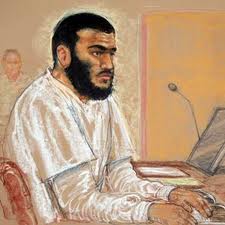
 Guantanamo Bay, Cuba – A seven-person military jury panel returned a recommended sentence of 40 years incarceration yesterday for Guantanamo detainee Omar Khadr. Khadr recently confessed to being an al-Qaeda combatant and pleaded guilty to the July 2002 grenade murder of SFC Christopher Speer after a battle at an al-Qaeda compound in Khowst, Afghanistan. Khadr, 15 years old at the time of the killing, has been in American custody since being immediately apprehended after the attack. Under the plea agreement terms, not released to the jury, Khadr will serve no more than eight years in U.S. and Canadian custody. Key to the jury’s finding was the testimony of Michael Welner, M.D., forensic psychiatrist and Chairman of The Forensic Panel, who addressed Khadr’s prospects of future dangerousness.
Dr. Welner consulted to government prosecutors on numerous issues, and the case witnessed a number of pivotal achievements that led to its eventual resolution. Prosecutors originally contacted Dr. Welner in April 2010 after the defense retained three senior mental health professionals – Laurence Steinberg, Ph.D., Ret. Brigadier General Stephen Xenakis, M.D., and Katherine Porterfield, Ph.D. The defense had made Khadr’s allegations of torture a centerpiece in their argument to suppress his statements to U.S. interrogators, and emphasized Khadr’s age at the time of the crime in mitigating his criminal responsibility.
The earlier involvement of Dr. Welner resulted in the first decision of a military court to compel an examination by a prosecution mental health expert in a disputed confession matter. That videotaped encounter was one of over 150 sources of information ultimately reviewed by Dr. Welner in his analysis of Khadr, including his collateral interviews of twenty interrogators at Bagram Air Force base and Guantanamo Bay, and intelligence officers and guards at Guantanamo. The information Dr. Welner yielded ultimately had a major impact at the suppression hearing, and the August 2010 opinion by Judge Col. Patrick Parrish in which he refused to suppress Khadr’s statements (see attached).
Confronting powerful evidence of his guilt, Khadr responded by attacking the Military Commission process. Soon afterward, however, Khadr pleaded guilty to murder, attempted murder (preparation and placement of roadside explosives), conspiracy, and other charges relating to his involvement in al-Qaeda.
With the sentencing hearing now the focus, the U.S. government asked Dr. Welner to appraise the 24 year-old Khadr’s risk of future dangerousness.
Rather than conducting a typical risk assessment using protocols based on samples and situations distinctly different from Khadr, Dr. Welner embedded the inquiry with the necessary cultural context to appraise risk of return to violent activities, conspiracy and criminality of radical Jihadism. Explained Dr. Welner, “Here was a member of al-Qaeda who had murdered, at a time when the war is not over, merely evolving. Risk originates from direct combat, facilitating the financing of terrorism, facilitating the organization of terrorism, and direct leadership. A protocol would have to consider and account for each of those challenges. This approach has to be taken, because re-entry to the community is a possibility for many radical Jihadists who have committed far less violent crimes.”
Dr. Welner’s methodology drew from extensive research on deradicalization programs from all over the world, information derived from hundreds of hours of record review, interviews with guards, intelligence officials, and Khadr (which the defense fought successfully to conceal from the jury’s attention), and research data from a Danish clinical psychologist who studied a large comparison sample of adolescent Muslim and non-Muslim inmates already in treatment to remediate their risk to the community.
Ultimately, Dr. Welner testified last week before the seven man military panel that Khadr was highly dangerous; the risk originated less from his likelihood of actual violence and more from his capacity to scale up the destructive capacity of Al-Qaeda in North America. Specifically, Dr. Welner concluded that:
- Khadr’s radical Jihadism has been extended beyond what he drew from his family by interacting closely with senior Jihadists who related to him in a pseudo-paternal capacity and being surrounded by Jihadists for the past eight years
- Khadr was invited to be a cell block leader by multiple blocks of Jihadists, deeply distrustful of others and determinedly hostile to Americans, who would not have asked for him to lead them but for their trust of Khadr
- Khadr was leading the others in prayer, the most sensitive aspect of the Jihadist’s day
- Khadr had exceptional stature within Gitmo Camp Four for many reasons, to the end that the Deputy Commander called him a “rock star” to the other inmates
- Khadr had stature for having killed an American soldier, and had bragged about this
- Khadr was held in high regard because his father was a senior leader in al-Qaeda
- Khadr’s father had given him exposure to the infrastructure of fundraising for terror and money transferring
- Khadr’s father had assembled an infrastructure for a terrorism front through a locally-based organization with affiliates in the United States that is thriving and available to Omar Khadr
- Khadr’s own defense team had proposed deradicalization twice, most recently in 2009 -- with an Imam whose own radical views have included that President Barack Obama is a “House Slave”
- Canada has no established deradicalization programs
- Khadr’s family remains radical Jihadist in ideology and practice and a family that repudiates radical Islamism is essential for deradicalization
- Khadr remained close to his family and will only return to their influence when he leaves custody
- Khadr’s family expects him to lead them and he is the most capable to do so
- Khadr expects to return to his family in Toronto
- Khadr’s Jihadism is a source of self esteem that continues to be fueled by his family
- Khadr has charisma and excellent English and multilingual skills, and the relationships with media propagandists that would give legitimacy, star power, and raise awareness to the face of al-Qaeda or whatever other radical institution he affiliated with, including those thriving “peaceful” organizations with terrorism support arms that his father had set up
- The connectivity Khadr already has in the network of radical Jihadism is global
- The contacts Khadr has in radical Jihadism are high level
- Records from Guantanamo demonstrate that an inmate was heard talking to him this year about “good news, God willing, from al-Qaeda in Yemen” around the time of the underwear bombing and other Yemen-inspired incidents
- Recidivism from Guantanamo is much higher than the 20% reported and released DOD figures, for a number of reasons – including detainees released from GTMO to confinement elsewhere, where there is no opportunity to re-engage; poor infrastructure for tracking; detainees who cross borders and change their names and are lost to follow up but very much involved in radical Jihadism
- Recidivism from Guantanamo released teenagers is at least over 40%, allowing for the same factors that render these statistics underestimates
- Khadr is devoutly religious, and the level of religiosity is a poor prognostic sign in the young Muslim inmate
- Khadr is angry, resentful, and blames others for his predicament
- Khadr does not have remorse for his actions; while in the past he bragged about killing “Americans,” more recently he declared he had never exercised a choice
- Khadr, as a person who does not take personal responsibility, would do more poorly in a setting such as deradicalization in which he would need to take ownership of his mistakes and crimes
- Khadr is not Westernized in his values, which is associated with a poorer prognosis
In rebuttal, the defense elected not to call any of the psychiatrist and psychologists assisting them, as prosecutors poised to recall Dr. Welner in rebuttal. “From the inside of the Khadr case, no ‘alternative presentation’ of Mr. Khadr emerged, because at long last, there is no alternative presentation that can be credibly advanced. His mental health experts were taken in by him and professed his innocence – only to have the rug pulled out from under them when he pleaded guilty. Like his assertions of torture, these fictions are part of what define the Khadr case,” noted Dr. Welner.
The jury deliberated over two days, revisiting exhibits and earlier testimony, before recommending a 40 year sentence. The sentence provoked a strong outcry among Khadr advocates. Dr. Welner, however, reflected differently.
“The public narrative of Khadr at GTMO is a hoax,” he explained, “a myth that has sullied the United States Government with false allegations of mistreatment of a child soldier.” The Welner evaluation, which resulted in a 65 page, still sealed, report in July 2010, demonstrated the parallels between Khadr’s claims and al-Qaeda manuals that call upon detained terrorists to claim torture in custody. Claims of physical abuse were not at all supported by ample contemporaneous documentation and data from the interviews of many uninvested witnesses. “Some detainees have been abused and traumatized in U.S. custody; not this detainee,” concluded Dr. Welner.
Nor is Khadr a “child soldier” as we have come to appreciate the tragic experience of child soldiers in Africa. “Omar Khadr was neither kidnapped into war, did not flee his home after being forced to commit atrocities, was not drugged into desensitization toward violence, was not groomed into escalating violence and was no naïve boy cast adrift. Rather, he was one Khadr sibling who chose violence, was translating for his father in the conduct of his activities as a senior al-Qaeda terrorist, was worldly and well-traveled, spoke openly of wanting to kill a lot of Americans, and engaged in martyrdom-motivated murder as soon as he had the opportunity – with neither drugs nor outside coercion,” explained Dr. Welner.
Even more notably, added Dr. Welner, “He is now 24 years old, has had much time to reflect, and is glorified for what he has done, rather than horrified by it. His shallow expressions of remorse speak volumes about how his maturing has not diminished his identification with radical and destructive ideology, in which he has been further marinated in a Guantanamo prison dominated by extremists, not moderates or Western influences. In an effort to placate the international community’s demands to accommodate the radicals’ comfort, Guantanamo is, in my experience, a place where the terrorists feed off each other, just without the weapons and logistic support to do anything more until they are released. So the UN is happy, but other countries who know Guantanamo as I do would never take such inmates back for the danger they pose.”
Going forward, Dr. Welner recommends that Khadr’s defense team and Khadr’s advocates “immediately initiate efforts to deradicalize him. Expose him to serious moderate Muslim Imams who can detoxify the poisonous violence of the radical Jihadists’ precepts, develop other Westerners who can represent healthy role models for him, and to push him to embrace personal responsibility rather than continue to disingenuously blame everyone else and assert that he is a victim. One day he will get out; his continued time in custody is an opportunity to enhance public safety. I hope that Khadr looks in the mirror and makes his choices wisely, and that anyone close to him reinforces that radical Jihadism is a devolved thinking that has no place in a civilized community – not Canada, not America, not Afghanistan – nowhere.


